MHI
Article Number 8:
Hybrid ovens: Are they more uniform?
Convection will assist uniformity in a convection environment for heat treatment, testing, and melting. See for example A High–Capacity Melt Furnace for Reduced Energy Consumption and Enhanced Performance” (Overview) by M. Fu, K. Staples, and V. Sarvepalli, May 1998, pg 42-44 or https://slideheaven.com/simulating-convective-die-heating-for-forgings-and-pressure-casting.html. Very
often convection is additionally introduced in a radiation oven/furnace. Does this help the uniformity?
The following experiment describes the results of just such an investigation.
The pictures below show a 550°C multi-rack hybrid oven fitted with a VTA-750-2GC (on the rear of the furnace) to provide convection. The independent control
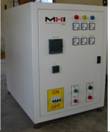
panel for the oven and VTA assembly is also shown. The conclusions discuss the uniformity increase in the oven. The conditions selected are when a radiative heater could see disrupted line-of-sight heating.
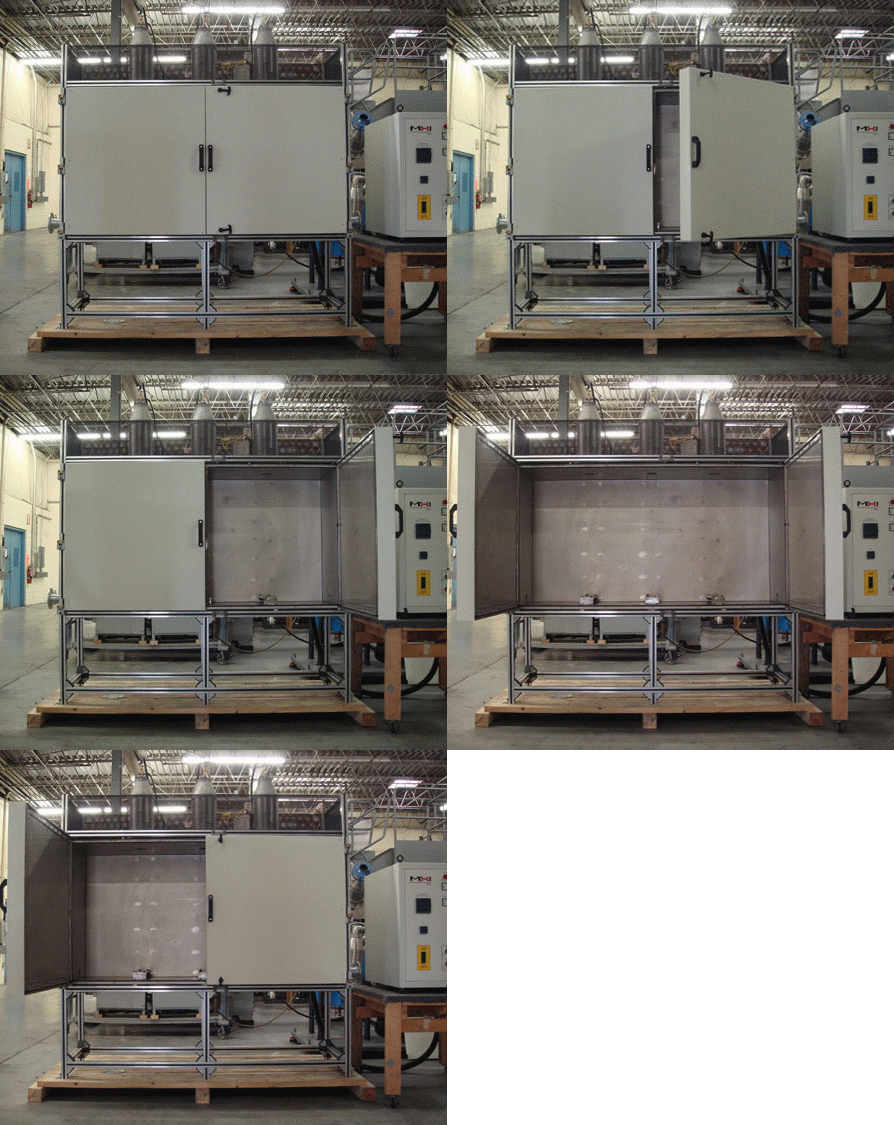

Figures
above show the front of a typical oven with the door opened and the rear where the
VTA convector has been fitted. The picture on the extreme right is the
MHI control panel for the furnace.
Specifications of test hybrid oven
Wall to wall chamber size: H 600mm X W 700mm X D600mm
Insulation: 2″ vacuum formed alumina silica boards on all sides
Temperature of oven: 550°C maximum. (other ovens tested at
350°C and 900°C please contact MHI for test reports). Review design criteria.
Radiative heating:
MHI heating coils partially embedded in fiberboards on two sides of the oven,
delivering 14kW in 3-phase configuration.
Convective heating:
MHI Model VTA750-2GC hot air blower capable of producing a maximum of 900°C air temperature.
Exhaust Vent: 2″ dia vent adequately located. Location of the vent is very important.
Controls: As shown in picture above (3-phase system). VTA control set in control panel. VTA speed set to give temperature
of 550°C.
Key control features of the oven
-
The 14kW radiative heaters are connected in 6-wire delta / star configuration. The temperature controller is provided
with a high alarm. This alarm is set 50 °C less than the desired set point. At start-up, the heaters come ON in delta configuration. This provides full power for rapid ramp up to temperature. Once the temperature reaches the alarm set value, the alarm output relay switches the heating elements into star configuration where the heating elements run at half the rated capacity in order to save energy. -
With the 50% power control provided by the 6-wire delta / star configuration, a + / – 1 ° C control accuracy can be achieved by simple ON/OFF control.
Experiment
-
In the delta configuration on start up, the oven reached 320°C in eight minutes. The alarm (for change over from delta to star was set 30 ° C below the set value of 350 °C). At 320°C, the alarm kicked in and changed the heating element load to a star configuration thus reducing the demand power by half. The large oven reached the set value of 350°C in the 12th minute. From there on, the control system t/c controlled the oven with a + / – 1 °C control accuracy.
-
The temperature range chosen for the tests (i.e. between a 100°C and 900°C) is not the best for only radiative heating insofar as uniformity is concerned. Note complexity of trays and shelves inside the oven. Thus it was meaningful to analyze the effect of VTA convection on the uniformity.
-
Thermocouples were located at six positions namely corners, face-walls, center and of-center locations in the
furnace. -
Conclusions are given below.
Conclusions of uniformity improvement with a Airtorch® type convection generator. Consider also steam as a process gas
-
During the first run, the VTA was not turned ON. During this run, a variation of + / – 25 to 30°C was observed on the 6 point temperature measurement. However the delta star improvement was activated. This clearly impacted energy use.
-
When the VTA was turned during a subsequent run the furnace variation reduced dramatically to + / – 6 °C. Note that this is a very acceptable value for such
a large oven in the mid temperature range. It appears that the convection vastly enhances the uniformity over other possible techniques employed. -
The conclusion is that the automatic switch over to a star configuration reduced the energy demand – the VTA Airtorch® assisted dramatically in improving the uniformity without adding in any significant manner to the power demand.
Disclaimer
Although this is a report submitted to MHI, there is no independent authentication of the data or experiment by MHI. The amount of uniformity enhancement, if any, will vary from installation to installation.