Water: So many states, so many uses.
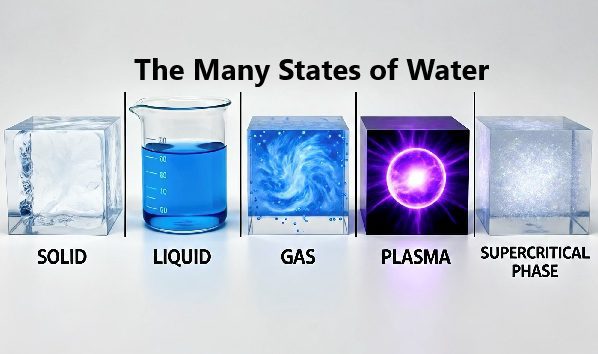
- Did you know there are many states of water?
- Solid water is seen on Earth almost always as a crystalline, six-sided form (hexagonal), reflected in snowflakes.
- But on our Moon and other places in our universe, water is also often found in an amorphous solid state. But often mixed states are observed.
- On Mars: Martian polar caps and subsurface permafrost sit between ~150 K and 210 K—warm enough for water to crystallize into regular hexagonal ice (hexagonal crystalline).
- On our Moon: Permanently shadowed lunar craters cool to 30–40 K, preserving amorphous ice from comet impacts, while slightly warmer crater edges and micrometeorite impacts anneal patches into crystalline ice.
- In Saturn’s Rings: It’s crystalline. Despite cold temperatures, tidal heating and sunlight warming keep ring particles around 70–110 K with enough thermal and collision energy for water to crystallize.
- Comets and Interstellar Dust: Mostly amorphous. Water vapor freezes directly onto dust grains in deep space (<50 K), forming low-density amorphous ice, although comets briefly form crystalline pockets when warmed near the Sun.
- Water is also used under supercritical conditions (a state that is a fluid with gas- and liquid-like properties but no surface tension).
- We use water in almost all its states. Solid state for cooling, Liquid state to stay alive, Gaseous steam for industrial and cleaning objectives, and plasma and supercritical states used in coffee making to novel industrial energy innovations. See applications of steam here.
 MHIUSA
 MHI Inc., USA

 MHIInc.,USA