
Did you know Energy Efficiency is tricky?
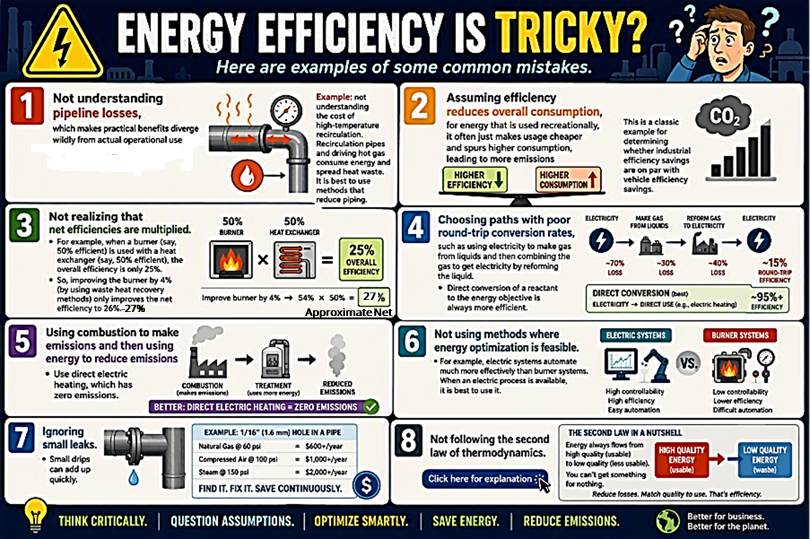
- Not understanding pipeline losses, which makes practical benefits diverge wildly from actual operational use due to complex building controls
- Example: not understanding the cost of high-temperature recirculation. Recirculation pipes and driving hot gas consume energy and spread heat waste. It is best to use methods that reduce piping.
- Assuming efficiency reduces overall consumption. Depending on the use, sometimes it just makes usage cheaper but spurs higher consumption, leading to more emissions
- This is a classic example for determining whether industrial efficiency savings are on par with vehicle efficiency savings. Yes, calling for industrial thermal efficiency with no emissions is better because it limits consumption more efficiently.
- Not realizing that net efficiencies are multiplied.
- For example, when a burner (say, 50% efficient) is used with a heat exchanger (say, 50% efficient), the overall net efficiency is only 25%. So, improving the burner efficiency by 4% (by using waste heat recovery methods) only improves the net efficiency by a percentage or so, i.e. to 26-27%.
- Choosing paths with poor round-trip conversion rates, such as using electricity to make gas from liquids and then combining the gas to get electricity by reforming the liquid.
◦ Direct conversion of a reactant to the energy objective is always more efficient.
- Using combustion to make emissions and then using energy to reduce emissions
◦ Use direct electric heating, which has zero emissions.
- Not using methods where energy optimization is feasible.
◦ For example, electric systems automate much more effectively than burner systems thus leading to better controllable processes. When an electric process is available, it is best to use it.
- Ignoring small leaks.
◦ Small drips could add up quickly.
- Not following the Second Law of Thermodynamics. Click here for explanation.
Solution: Avoid GHG (Green House Gases) production.
- The electrification of modern large industrial heaters now offers unparalleled energy efficiency, which can significantly reduce global energy use.









 MHI Inc., USA