The Bronocice pot, discovered in Poland and dated to 3500 BCE, features the world’s oldest known drawing of a four-wheeled cart.
But friction was not formally studied until recently. Leonardo da Vinci studied friction in 1493, but his pioneering notes remained unpublished for 200 years. Friction is the contact force that opposes the relative motion or tendency of motion between two surfaces.
Rolling is different than sliding or slipping, as it prevents bonds from forming and then breaking as they do in sliding friction. This vastly minimizes energy loss. During rolling, the point of contact between the wheel and the ground is momentarily stationary relative to the surface. It lifts straight up rather than scraping sideways. This resistance is known as rolling resistance.
Sliding forces cause continuous shear of microscopic surface welds. When a flat object slides, microscopic peaks and valleys on both surfaces lock together. Moving the object requires constantly shearing or ripping these interlocking bonds, which requires a large amount of force. This force relates to the normal contact force across the sliding surfaces and the coefficient of friction.
A perfect wheel touches the ground at only a single microscopic line or point (no friction). But zero friction will prevent acceleration or braking; therefore, optimal friction is required. A flat or flattened object spreads its weight across a massive surface area, maximizing microscopic contact.
Racing tires, known as slicks, are bald to maximize the rubber surface area in contact with the ground.
Friction also leads to stability. Tires have treads to channel away water, mud, and snow so the rubber can maintain a firm grip on the road.
In the world of transportation, about 33-36 Exajoules are lost annually to friction, and only 3.3- 3.6 Exajoules are lost to wear. New ideas about entropy generation rates can reduce permanent energy loss from friction.
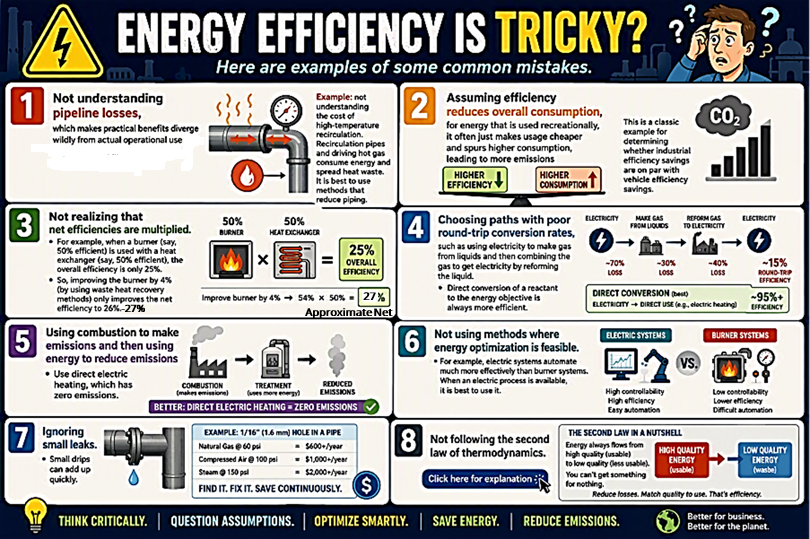
Compact megawatt heating systems now available achieve over 98% energy efficiency. The return on investment is quick.
Switching industrial heating to electric heating can be more cost-effective per kW than converting vehicles to EVs.
https://mhi-inc.com/wp-content/uploads/2026/08/mhi-did-you-know.png318584Jorge Carbwoodhttps://mhi-inc.com/wp-content/uploads/2018/10/MHI-INC_logo-300x41.jpg Jorge Carbwood2026-08-21 07:55:522026-08-22 08:15:37Did you know rolling frictional resistance is much lower than sliding frictional resistance?

 MHI Inc., USA