Review of Radiative Heating and Radiative Power
When an object is above 0K (Zero Kelvin), it emits electromagnetic (em) radiation. The object has a natural glow whose intensity and type of radiation depend on its surface temperature. Such emitted radiation can be thought of as wave-like with many frequencies; i.e., it displays a spectrum of wavelengths- the same as velocity/frequency. The velocity of em radiation in a vacuum is fixed. The radiation can also be thought of as comprising massless photons with an energy probability distribution that depends on T, the temperature in Kelvin (more precisely, on kT, where k is Boltzmann’s constant). Such a photon-based explanation of radiation is the more accepted theory of light/electromagnetic radiation, as it is the quantum-mechanical description of light. According to our current understanding, photons produce the electromagnetic field, which gives rise to a local gauge symmetry and the laws of quantum field theory. However, wave-particle duality is not critical for heat-transfer calculations because the experimental results follow the Stefan-Boltzmann and Planck radiation laws, as discussed below.
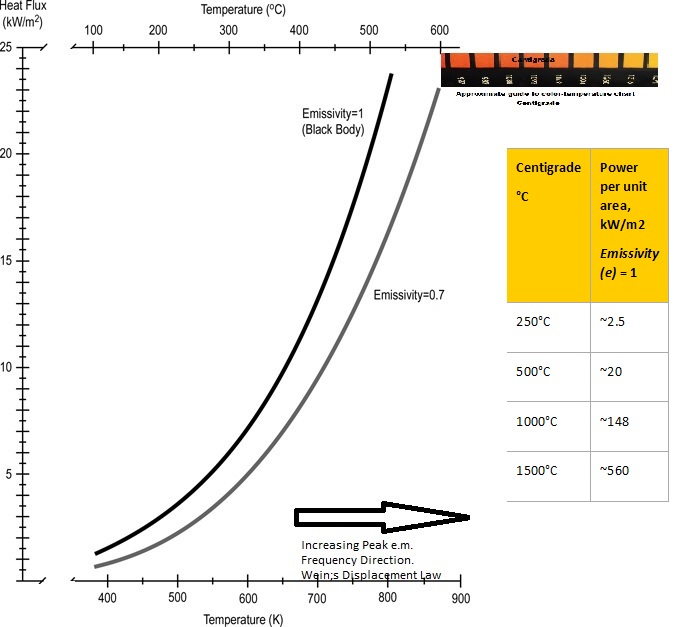
The Stefan-Boltzmann Law gives the maximum rate of radiation emitted (Power) by a surface with area A, integrated over all wavelengths. Radiated Power Intensity, P (W) = e.s. A.Te^4, where e is the emissivity, Te is the temperature in Kelvin of the emitting surface, and s is the Stefan-Boltzmann Constant = 5.6703 x 10⁻⁸ W/m2K4. Emissivity (e) is a relatively complex variable that encompasses several physics laws. The emissivity depends on temperature, wavelength, and the angle of emission. It is the ratio of the power radiated by a material surface to that radiated by a blackbody surface at the same temperature. For a blackbody, e = 1. The emissivity e ranges from 0 to 1 for solid materials. Radiation can exert pressure – a simple way of thinking about this is that the rest mass of photons is zero. Still, when they travel at the velocity of light, their effective mass is non-zero because they can transfer momentum. Thus, they have momentum and can exert force when encountering an obstruction. The plot below shows radiation power per unit area as a function of temperature (the Stefan-Boltzmann law). A table also shows how steeply total radiated power increases with emission-surface temperature.
Often, continuous spectra appear when free electrons change speed through interactions with a potential and thus radiate photons with a continuous frequency spread. This is called Bremsstrahlung radiation. Further below, we discuss the wavelength spectrum, or the probability distribution of emitted photon frequencies (namely, Planck’s radiation law).
An important law called Kirchhoff’s law states that for a material in thermal equilibrium, the emissivity ε at any given wavelength and the absorptivity α at the same wavelength are equal (at a fixed surface temperature). A blackbody is a perfect absorber and a perfect emitter across all wavelengths. When radiation encounters an object, it may be absorbed, reflected, and refracted/transmitted. For heat (infrared radiation), transmission and refraction may occur only through a few atomic layers, where the energy is “absorbed.” One may ignore transmission through more than a few atomic layers for such thermal (heat) radiation (predominantly infrared IR spectrum comprising only long wavelengths, 1- 100 micron range). Most solid bodies, as they are, are opaque to this radiation.
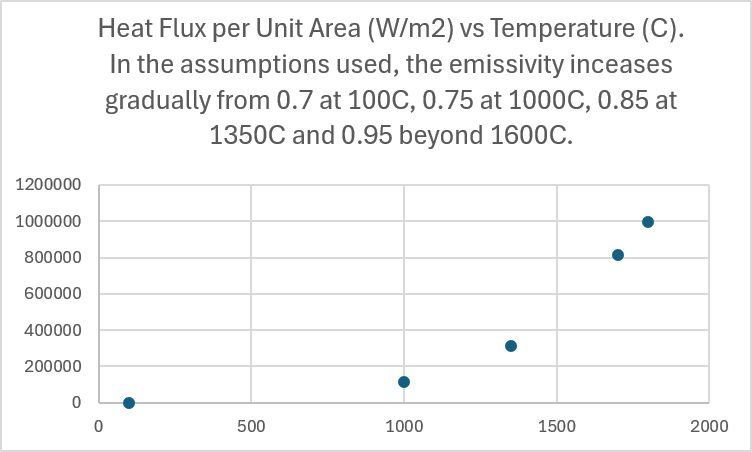
Heat Flux per Unit Area Chart
An object is called a blackbody if the following formula holds for all frequencies: a = e = 1. What is commonly known as heat radiation lies in the infrared region (wavelengths longer than 1 micron to about 18 microns). It is common to assume emissivity is independent of wavelength when solving engineering problems related to heating by radiation. Such an approximation is called the grey-body approximation (see example below). Grey-body approximations are commonly made across the infrared (thermal radiation) spectrum. The net power transfer P is described below in terms of the areas and temperatures of the absorbing and emitting surfaces. The subscripts a and e stand for the absorbing and emitting surfaces of the radiation, respectively. The subscripts h and l indicate a particular wavelength. 
For the Earth, we consider two types of emissivity, one that includes the troposphere and one that does not. These are (a) Earth’s Surface Emissivity (~0.95), which measures how efficiently the solid and liquid surfaces of the Earth (rock, soil, water, vegetation) radiate thermal infrared energy into their immediate surroundings, and (b) the Earth’s Space-Viewed Emissivity (~0.78), which represents the effective efficiency of the entire planet-plus-atmosphere system. It is calculated by comparing the radiation actually escaping into space with what a perfect blackbody would emit at Earth’s surface temperature. These two numbers align only in the 8-to-13-micron spectral band (see figure on this page) (excluding a sharp ozone absorption peak).

Earth’s effective emissivity, as viewed from space, is decreasing with climate change. In contrast, local surface emissivity shows highly localized changes (increasing in some regions and decreasing in others) depending on the material replacing melting ice or other color changes. The peak wavelength (Wien’s peak) and the typical FWHM (Full width at half max.), i.e., 0.61 to 1.81 times the peak wavelength at a temperature, are also shown.) Wien’s peak is discussed further below.
The net power transfer, P, from a high-temperature surface to a lower-temperature surface by radiation is given by the Stefan-Boltzmann law:

Pe and Pa are equal for a grey body in thermal equilibrium, and el = al for the same surface by Kirchhoff’s law. The Sun is a blackbody with e = 1 because it is very hot and dense at its core. Although it is in equilibrium for all practical purposes (due to intense internal heating), it could exhibit temperature variations, albeit slowly, when measured across the surface. Most materials on Earth are at a lower temperature, with absorptivity and emissivity below 1, as discussed above. Note from the table above that radiation power increases with temperature; i.e., radiative power follows a power law of T^4.
Simple example: At 400 °C, the radiation power per inch of the 2″ diameter stainless steel rod (emissivity eh=0.15) is approximately 6.75 Watts/inch. At 450°C, it is 9.15 Watts/inch, an increase of ~87%. If the rod turned bluish, its emissivity may have increased to ~0.5, and the radiative power could be closer to ~30 Watts/inch for the same 2″ rod at 450C.
In the equation above, s is the Stefan-Boltzmann constant = 5.6703 x 10⁻⁸ W/m2K4. When calculating the power the Sun radiates to Earth, note that only a portion of the Sun’s area radiates to Earth. The radiation is received over a specific section of the planet; a large area of the world radiates energy away from the Earth. (where h refers to the high-temperature emitting surface, l refers to the lower-temperature absorbing surface, and A is the area). Note also that the law above applies to most situations. However, the application to structures where features have wavelengths less than the Wien wavelength -see below- could involve some correction terms. Typically, at room temperature, this correction applies to wavelengths below 10 micrometers, and at the MHI high-temperature device range, it is ~800nm.
| Wavelength Range
(Approximate only depends on the metal) |
Change in Emissivity
as the Temperature Rises |
Reflectivity Behavior as the
Temperature Rises |
| Infrared radiation typically greater
than 2.0 microns |
Emissivity increases | Reflectivity decreases (the surface absorbs more heat) |
| About 1 micron range radiation | Emissivity stays fixed | Reflectivity remains totally unchanged |
| Visible / UV typically
Below 0.5 microns radiation |
Emissivity decreases | Reflectivity Increases (the surface reflects more light) |
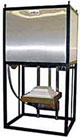
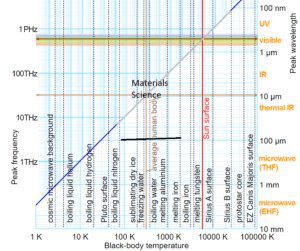
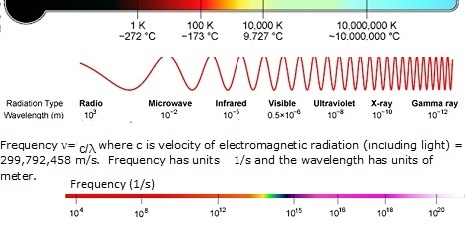
The electromagnetic spectrum is described by its constituent frequency or wavelength. The total radiation a surface emits at a given temperature encompasses several wavelengths. The relationship between temperature (T), peak wavelength (λ), and frequency (v) is shown below. Note that the visible spectrum region is only a tiny portion of the entire electromagnetic spectrum. Radiation from a body comprises multiple frequencies that may be considered to sum to a resultant wave. What is commonly known as heat radiation lies in the Infrared part (longer than visible light wavelengths). Ultraviolet and X-ray radiation are much higher-frequency radiation (shorter wavelengths). These are high-energy radiations and penetrate matter more than infrared radiation. Note that radiative power follows a power law of T^4. Free-radiating elements like Microheaters™, GlowPanels™, Thermoplates™, and Magnacoils™ are designed to maximize heat power output. In contrast, a closed-chamber furnace is optimized for maximum temperature and low power loss (insulated). When the transfer mechanism is convective, Airtorch® achieves the best power transfer. A breakthrough device called the Cascade e-ion may be employed when an extremely rapid power transfer is required.
The reflectivity (R) of metals is [1 – emissivity (e)]. Therefore, if you know a metal’s reflectivity, you automatically know its emissivity, and vice versa. A perfect mirror (Reflectivity = 1) will always have zero emissivity, while a perfect thermal radiator (Emissivity (e) = 1) will always have zero reflectivity. Emissivity and reflectivity, and their rate of change, depend on temperature and wavelength. For metals, it varies as shown below. For conductors, if you know the electrical resistance and the wavelength, you can calculate the emissivity. As temperature increases, electrical resistance increases, causing infrared emissivity to go up. At long wavelengths (infrared), normal spectral emissivity is directly linked to the metal’s electrical resistivity:
One can create composite alloys to achieve optimal reflectance and even optical cloaking. Between 2015 and 2019, articles on Cu-Sn high-reflectance mirrors appeared, effectively bridging ancient craftsmanship and advanced photonics with composite quasi-crystalline alloys. Mirror artisans produced mirrors with excellent reflectivity because the periodic copper-tin matrix provides the raw reflectivity. At the same time, the orderly distribution of the forbidden five-fold nanophases protects the surface geometry from optical degradation.
For conductors, if you know the electrical resistance and the wavelength, you can calculate the emissivity. As temperature increases, electrical resistance increases, causing infrared emissivity to go up.
e=4n/[(n+1)^2+k^2)]
|

|
Comparing typical Gas Burners to Electric GlowPanels™? Compare the Power and Temperature Power Rating Conversions and Basics of Thermodynamics. 90,000 BTU/hour = 26.4 kiloWatts (kW) The radiation intensity increases with the temperature
* Source: https://en.wikipedia.org/wiki/Flame. Note that the average temperature is not the peak The temperature could be higher. The comparison includes MHI-patented materials. Glow panels offer non-turbulent heating. Compare the Power Density of Lasers, Sunlight, Gas Flames, and More. |
Gas Absorption of CH4, CO2, N2O, and H20 as a function of Wavelength and Wien’s Temperature Peak in Celsius and Fahrenheit.
The color of the planets: Planet surfaces, or atmospheres, reflect and absorb sunlight. The surface of Mercury is thought to be made up of igneous silicate rocks and dust. Mercury has a dark gray, rocky surface with thick dust. Venus is blanketed with a dense carbon dioxide atmosphere and sulfuric acid clouds that give it a light yellowish appearance. Earth shows its blue oceans, white clouds, and green and brownish land. Mars, covered with fine iron oxide, is red-orange. Jupiter is a giant gas planet with an outer atmosphere mostly made of hydrogen and helium, with small amounts of water droplets, ice crystals, ammonia crystals, and other elements. Clouds of these elements make shades of white, orange, brown, and red. Saturn is also a gas giant with an outer atmosphere mostly made of hydrogen and helium. Its atmosphere has traces of ammonia, phosphine, water vapor, and hydrocarbons, giving it a yellowish-brown color. Uranus is a gas planet with methane mixed into its mainly hydrogen and helium atmosphere. This methane gas gives Uranus a greenish-blue hue. Neptune also has some methane gas in its mostly hydrogen and helium atmosphere, giving it a bluish color. Did you know plasmized gas has several tell-tale colors?
Radiation can also be considered to comprise photons with a spectrum of energies (the wave-particle duality). A photon is a fundamental particle that represents a quantum of electromagnetic radiation. The energy of an individual photon is higher for photons of a higher frequency. Only particles bound in potentials get quantized energies. Thus, the photons that mediate transitions between these quantized energy states are quantized. This explains why, even though the Planck radiation equation is expressed as a continuous variable of wavelength, atoms’ emission and absorption spectra yield only discrete line signatures. From solar cells to concrete testing to metal surface hardening, MHI devices use these differences between free and bound electrons to perform specific applications. The effective mass from the famous equation E=m.c^2 implies a vector momentum, which, when changed, gives rise to a vector force. However, note that 1 J of energy is ~0.11 x 10^-16 kg for em radiation. Compare with 9.1 x 10^-31Kg as the mass of an electron at rest. So the photons can exert a punch on electrons, as described by Ohio-born A. H. Compton (1892-1962), for inelastic scattering.
Planck’s energy law gives the relationship between energy and frequency for a photon: E = hν, where E is the energy per photon, ν is the frequency of the photon, and h is Planck’s constant, equal to 6.626×10⁻³⁴ J · s. When considering the wave-particle duality, the frequency of a wave is its rate of oscillation and is measured in Hertz, the SI unit of frequency, where one Hertz is equal to one oscillation per second. A photon carries energy proportional to the ‘frequency‘ of the radiation (or inversely proportional to the wavelength, as the velocity is constant). Photons belong to a class of fundamental particles called bosons. Photons are the force carriers of the electromagnetic field. Photons are not conserved. Photons have zero rest (invariant) mass. The number of photons per second is inversely related to the electromagnetic/light frequency (probability). The photons/second = Pλ/hc = P/hν, where P is the Power in Watts, c is the speed of light, h is Planck’s constant, and ν is the frequency. The energy E of a photon is given in electron volts. Red light photons are about 1.7 eV, and blue light photons are about 3.2 eV (or red light has a wavelength of about 0.8 microns and blue light has a wavelength of about 0.3 microns). Note that 1eV=1.60218e-19 Joules.
Note that the energy of a photon in eV (electron volts) is equal to 1.239/ (Wavelength in microns).
Planck’s Radiation Law gives the radiation power density as a function of wavelength and temperature for Black Bodies (shown in the plot(s) below) – also called the Planck formula. S represents radiation power density (W/m3 per steradian), or Spectral Irradiance per steradian, obtained from Planck’s radiation law as a function of wavelength. Definition of Steradian: An area on a sphere equal to the square of its radius, when observed from its center, is precisely one steradian. This is similar to the relationship between arc length and the angle in radians in two dimensions.
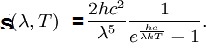
The radiated power density (S) as a function of wavelength is shown below for different temperatures. Planck’s constant h = 6.626×10⁻³⁴ joule-seconds (J.s), and c is the velocity of electromagnetic radiation. Note that the power density increases with the temperature for any given wavelength. A peak (denoted as λmax) is also noted in the S vs. wavelength plot for any given temperature. This peak shifts to a lower wavelength (higher frequency) as temperature increases. Wien’s radiation constant relates the peak wavelength and temperature. The mathematical relationship is λmax. T = W, where W is a radiation constant, λmax is the peak wavelength, and T is the absolute temperature. The radiation constant, W, is called Wien’s displacement constant and equals 2.8985×10⁻³ K · m. The Planck equation (shown alongside the plots below) can be integrated over all wavelengths to yield the Stefan-Boltzmann law discussed above. The units for the three graphs below should not be confused with the units of P (the total power given by the Stefan-Boltzmann law). The radiation equation was originally derived semi-empirically before the quantum/statistical methods are discussed further below.
The power density S can also be derived by considering radiation as composed of photons. When multiplied by frequency, Planck’s constant value, 6.626176 x 10^-34 J · s, is the smallest energy quantum that a corresponding photon can carry. From a knowledge of the gravitational constant, the Planck Energy based on the Planck Mass is Mpc2 equal to 1.9561x 10^9 J. Similarly, a Planck’s length ~1.6 x 10^-35 m (the distance traveled by radiation during one Planck-time is one Planck-length) based on Planck’s time. ~5.39 x 10-44 seconds. These are the smallest scale(s) in the universe (because of the Uncertainty Principle); however, the numbers are too small to measure directly or verify. Although not directly related to the uncertainty principle, those interested should also study Gödel’s incompleteness theorems on the limits of knowledge within formal systems.
Planck’s radiation formula for photons is an example of the energy distribution predicted by Bose-Einstein statistics, reflecting that the particles (photons) are indistinguishable and have integer spin. Two particles can be distinguished if their separation is significant compared to their de Broglie wavelength (λ=h/p, where p is the momentum for a massless photon, which is E/c). For air-gas molecules at STP (standard temperature and pressure), the molecules are separated by 3 nm and have de Broglie wavelengths of ~0.03 nm, which is much smaller. The kinetic energy is thus spread in a manner that reflects a Gaussian-type distribution of the kinetic energies of the gas atoms. The mean energy in the distribution measures temperature.
On the other hand, electrons and photons are indistinguishable particles. Still, because of their quantum spin numbers, they may follow different energy-distribution statistics: Fermi-Dirac statistics for electrons and Bose-Einstein statistics for photons. For completeness, we should mention that lattice vibrations (phonons) are indistinguishable particles but may follow different statistics at different temperatures. At extremely low temperatures, even the larger particles (atoms) can have longer de Broglie wavelengths (i.e., as p (the momentum) tends to zero). So especially when the atoms are highly concentrated and at a very low temperature, they can be considered as indistinguishable particles and ‘condense‘ into what is called zero-friction superfluids. One should note that “the standard model,” which describes the make-up of all matter with numerous fundamental particles (even inside protons, neutrons, and other constituents), can now integrate almost all interactions of particle intensity probabilities; however, Planck’s law is still OK for thermal descriptions. It does not matter which particles are being studied – nucleons or electrons- the quantum mechanical calculations can progress well within the Heisenberg Uncertainty Principle for making good predictions of forces and probability-polarity. Regardless, experimental diffraction at tiny length scales is not yet available to properly validate these concepts.
- Planck’s Law describes the maximum radiative power density. Power is the rate of energy change.
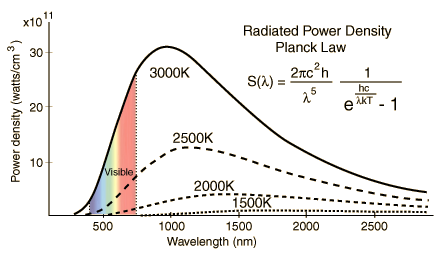

- Wien’s Displacement Law describes peak location (the specific Wien wavelength for a given temperature; y-axis).

- To draw analogies between the two curve shapes (temperature vs. wavelength and power density vs. wavelength with distributions) – see Gaussian and exponential distributions for PDF and CDF that describe the entropy generation rate.
- The corresponding photon energy range for visible colors is shown below.


These graphs are reproduced from the open-source “Physics.”
Note that the energy of a photon in eV (electron volts) is equal to 1.239/ (Wavelength in microns).
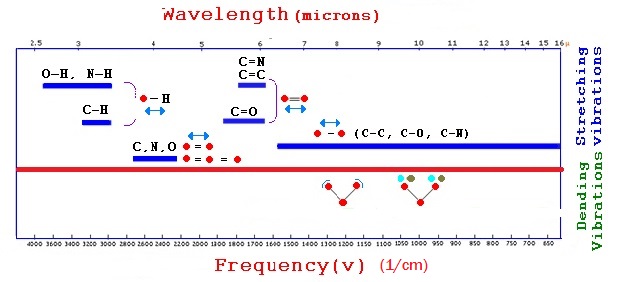
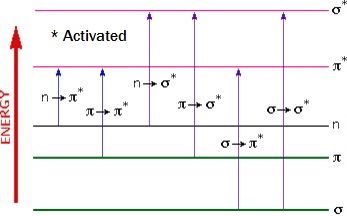
Radiation interacts with chemical bonds. In the visible and UV regions, ionic dissociations (excited states) are feasible. The vibrational states are affected in the infrared region, as shown below.
Sun/Greenhouse effect: The Sun is a blackbody. The greenhouse effect refers to Earth receiving radiative energy with the wavelength distribution of the solar spectrum (from the Sun, which has a surface temperature of ~5778 K), but then emitting and reflecting radiation associated with Earth’s much lower temperature (~300 K). The emission is mainly in the IR (infrared wavelengths). Molecules absorb characteristic wavelengths. Some of the emitted and reflected (polarized) radiation from Earth falls in absorption bands characteristic of CO2, water vapor, fluorocarbons, and gases in the air such as CH4, SO2, NOx, and others, trapping a considerable part of the emitted and reflected IR radiation (heat). These interactions, whether elastic or inelastic, influence reflection and radiation. The Sun may be considered to be a black body (e=1). In contrast, the Earth may be regarded as a grey body (e=0.8) for approximate energy-distribution calculations. Only a grey body can reflect.
Note that the emissivity of an object’s integrated emission is a temperature function. For approximate energy calculations, we can infer that the Sun radiates 6.3 x 10^7 W/m2. The Earth (over the atmospheric area of the planet) receives ~1.3 x 10^3 W/m2 sunlight and radiates (from its actual surface) ~(250-350) W/m2, which is considerably absorbed by gases in the atmosphere. The units of P in the equations above for power transfer between objects at two temperatures are W or W/m2, from the Stefan-Boltzmann law. The units of power density above S are W/m3 or W/m3 per steradian (y-axis of the graphs above), i.e., from Planck’s Radiation Law formulation above. The conversion between P and S at equilibrium involves Wien’s radiation constant or integration over the spectrum (all wavelengths) as described by Planck’s Law for the Energy of a Photon, namely that E = hν, where E is the energy per photon, ν is the frequency of the photon, and h is Planck’s constant equal to 6.626×10⁻³⁴ J.s.
-
- Behavior: Emissivity remains relatively constant and high from normal incidence to about 60 degrees; then the emissivity drops sharply.
- Grazing Angle: At a grazing angle, i.e., 90 degrees, the reflectivity approaches R=1
- Brewster’s Angle: At a specific angle called Brewster’s angle, R=0 (R drops to zero), meaning e=1
- Clean metals have very low emissivity at normal incidence. However, as the angle increases, e increases significantly as the polarization) increases significantly, often peaking at a high value around 85 degrees
- Just like dielectrics, at the extreme grazing angle, reflectivity for both polarizations is very high, causing e=0
- The total hemispherical emissivity (averaged over all angles) for a polished metal can be up to 25% higher than its normal emissivity.


-
- For all materials, emissivity ultimately forces its way down to e=0 at a 90-degree grazing angle.
- Dielectrics maintain a high, steady emissivity that drops off past 60 degrees
- Metals start with a low normal emissivity but experience an upward spike in emissivity at steep angles due to parallel polarization.
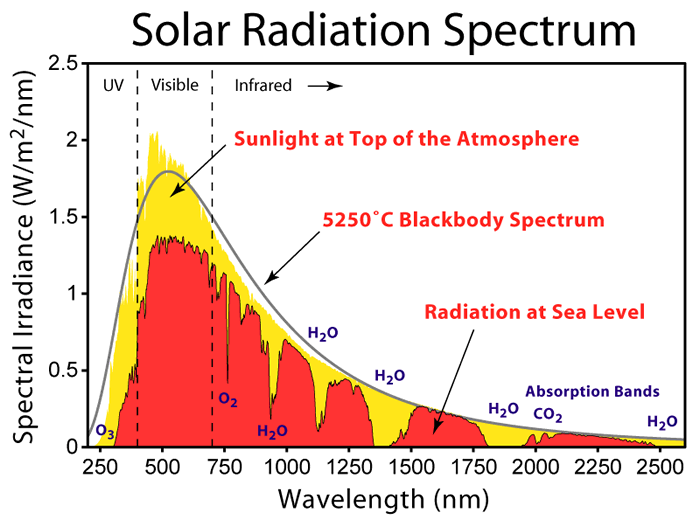
Shown below is the color spectrum of visible radiation and the energy associated with a particular wavelength of light. The solar spectrum credit is to https://en.wikipedia.org/wiki/File:Solar_Spectrum.png. Note that O2, O3, and H2O absorption spectra are captured in the center graph. Still, it does not call out methane absorption, which is a minor constituent (because of its low atmospheric concentration, 20-40 ppm level) but important when methane gas leaks are encountered (methane and other such gas lines (bands) absorb in the 1.62, 3.2, and 8.8-9.2 micron range).
Climate warming has led to the demand for deep decarbonization. The major greenhouse gases are CO2, NOx, SO2, and CH4. The last three are a much smaller component than carbon dioxide from fossil fuel combustion but are more potent drivers of the greenhouse effect. Natural gas has considerable methane content, as do biogenic sources.
The greenhouse effect explained in simple terms. Did you know?
- The Earth’s surface heats when sunlight hits it. The Earth’s atmosphere is not opaque to radiation from the Sun (which peaks at about 0.5 microns) and passes almost straight through to the Earth’s surface.
- The Earth’s surface radiates back at a lower temperature (8–14-micron radiation). In this spectrum, particularly near 8 and 14 microns, the atmosphere appears opaque to Earth’s radiation because strongly absorbing molecules such as CO2 absorb it (see chart below). CH4 and N2O absorb strongly in the 7.8–8.6-micron region, while H2O and CO2 absorb in the 14- 15-micron region.
- GHG molecules absorb this energy and try to reradiate at other wavelengths (this reradiation process can take 0.5 s to a second after absorbing Earth’s radiation). However, before they can reradiate, they collide (within 12 microseconds) with molecules such as N2 and O2, transferring the excess energy to the kinetic energy (temperature) of moving air molecules and warming the atmosphere.
- Notably, below 5 microns, the Earth emits very little thermal radiation, but N2O’s sharp peak at 4.5 microns is highly efficient at absorbing incoming solar infrared radiation, thereby also contributing to atmospheric heating.
- Although CO2 is nearly opaque to certain wavelengths of Earth’s radiation, increasing its atmospheric concentration broadens the absorption profile. Each time you double the CO2 concentration (e.g., from 280 ppm to 560 ppm), you increase heat trapping by about 3.7 Watts per square meter. Currently, it is 2.25 W/m2.
Rapid industrial electrification of MW industrial heaters is most likely the fastest method to deep-decarbonize quickly.
Another reason for the warming is that ice (a solid) reflects a much larger fraction of sunlight than water, which reflects only ~6% of incident solar radiation. See above for the relationship between reflectivity (R) and emissivity (e), namely, R=1-e. This happens because the extinction coefficient and refractive index differ between a non-electrically conducting liquid and a non-electrically conducting solid. Sea ice is essential to slow warming because it reflects sunlight (50-70%), reducing the energy absorbed at the surface. Changes in absorbed energy when less ice forms alter water currents/circulation patterns. An interesting observation is that snow (a semi-solid) can reflect ~90% of the incident solar radiation – even more than ice! This relates to differences in surface roughness and correlation length when comparing snow and ice surfaces. Any surface can be optimized for emission and reflection to improve the objective’s energy efficiency.
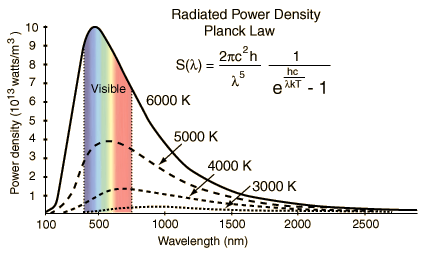
STEFAN-BOLTZMANN LAW: the units for P in the equations above for power transfer between objects at two temperatures are W or W/m2. The power density units for S are W/m3 per steradian (y-axis of the two graphs above), i.e., from Planck’s Law. Planck’s Law describes that the conversion between P and S at equilibrium involves Wien’s radiation constant or integration over the spectrum (all wavelengths). Wien’s law is λmax = hc/zkT, where z = 4.96511 (an integration constant). Here h is Planck’s constant, and k is the Boltzmann constant. Note also that pressure has units of J/m^3.
- Integrate Planck’s Law: Integrating the spectral radiance over all frequencies and directions yields the total blackbody energy density
- Divide by the Speed of Light: For isotropic (uniform) radiation, the radiation pressure (P radiation) is equal to one-third of the total energy density: (u/3), where u is the energy density)
Because energy density (u) is directly tied to the total radiance divided by the speed of light, the correct “scaling factor” to convert the energy flux into pressure involves dividing by c (the speed of light)
Link to review the use of the main spectral facility at Stanford University to measure the temperature dependence of absorption. Line broadening and emission transmission. Link to the corresponding MHI furnace page.
Radiation interacts with matter in quantized ways. The range of photon energies in the IR spectrum can interact with molecular vibrational states, as shown below. UV-Vis photons, with higher energy, can excite electrons to higher states in atomic, molecular, and conduction bands.
IR Spectrum Devices
Somewhere between 600 °C and 800 °C, the blackbody spectrum extends far enough into the visible to appear as a dull red glow. At temperatures of ~50 °C, almost all the radiated energy from the surface of a body or a wall lies in the infrared part of the spectrum (see above). The wavelengths in this part of the spectrum are of the order of (1000nm = 1 micron) and above. At low temperatures, the peak shifts to a higher wavelength and, as shown above, could be mainly in the visible range below 600 °C. Thus, the human body mostly loses radiation (heat) by emitting in the infrared (IR) region, which is invisible to the eye. The human body controls its temperature through a natural, automatic regulation process and tries to keep it around 37°C. An average human body emits about 100W of radiation at 37oC. This number increases with vigorous exercise.
Detecting human body movement requires particularly sensitive sensors in the IR regions. Night vision goggles have this feature: they accentuate IR and convert it to a more visible frequency the eye can detect. Almost all surface heating involves IR. Each quantum of IR has a lower frequency compared to UV. As frequency increases toward UV radiation, the waves penetrate more because they have more energy. The energy of a photon depends on the wavelength. UV shades are recommended because UV has a shorter wavelength than IR. Note that the radiation power of a surface increases with temperature and emissivity in a non-linear manner. Material emissivity also generally increases with temperature. However, emissivity and reflectance are not simple properties. Radiation is absorbed via mechanisms that involve allowed quantum states. Emissivity is associated with high-temperature measurements (> 300 K), and reflectance with low-temperature measurements (< 300 K). The dielectric constant has real and imaginary components and directly affects reflectance (mainly through the real part). However, the refractive index and texture-caused dispersion are noted in reflectance measurements; e.g., the reflectance for a shiny metal can often decrease with peak temperature or increase because of plasmonic influence.
Visible Spectrum Devices
Solar and UV panels can be of two types: (1) those that absorb all radiation (blackbody) in the solar spectrum, generally used for heating, and (2) those that selectively absorb to stimulate electron activity in semiconductors. These are classified as visible spectrum devices. Cascade e-ion devices may combine both types. Cascade e-ion devices can make oxynitride, carbonitride, nitride, and carbide surfaces/coatings of transition metals. Surfaces can be manipulated to absorb some wavelengths and reflect others. Such novel surfaces made by Cascade e-ion or D-e-ion devices also often impart antimicrobial properties. MHI’s patented high-emissivity and controlled boson, fermion, and photon stimulators are key to the next generation of power-producing surfaces. See also the deburr page for Golden/Blue surfaces/microstructures for iron, zirconium, and titanium alloys. As noted above, Kirchhoff’s law applies; however, transparent coatings can manipulate the amount transmitted or reflected at various wavelengths, e.g., glass or gold plating, or the more recently rediscovered copper-tin mirror materials. Variations in the types of surfaces enabled by the cascade e-ion are being discovered, e.g., a black body in the visible spectrum range can be covered with a layer (glass) that is transparent in the visible range but opaque in the UV or IR range. For example, hot water solar heaters may use such layering techniques.
How is light measured? What do Lumens and Lux signify? What is Brilliance?
Brilliance, in the context of light, relates to the photons per second our eyes detect. In the visible spectrum, the units of lumens (amount of light in the visible range) and lux are used to calculate/infer illumination, which usually pertains only to visible-spectrum objectives. Lumens are computed from the spectrum, or from the number of photons per second at the “light” frequencies, and converted to an absolute number in a slightly roundabout way. The luminous efficacy η defines the device’s efficiency for providing illumination in lumens per watt (lm/W). The illuminance Ev in lux (lx) is equal to the power P in watts (W), multiplied by the luminous efficacy η, divided by the surface area A (m2): Ev(lx) = P(W) × η(lm/W) / A(m2). Note that red is higher-wavelength radiation than violet. In terms of wavelength, the graphics above and below for photon energy (shown in eV) range from 720 microns to 390 microns (left to right). The power of radiation given in photons per second and the lumens are related to brightness by the number of photons per second in the visible range.
Luminous intensity is the perceived power per unit solid angle. Luminous intensity should not be confused with luminous flux, the total perceived power emitted in all directions. If a lamp has a 1-lumen bulb and the lamp’s optics focus the light evenly into a 1-steradian beam, the beam would have a luminous intensity of 1 candela. A candela is the luminous intensity, in a given direction, of a source that emits monochromatic radiation at 540×1012 hertz (green) and has a radiant intensity in that direction of 1/683 watt per steradian.
Different light emitters can now be compared – an LED source gives 90 lumens per Watt compared to an incandescent bulb, which is about 30 lumens per watt. Theoretically, one watt of power in the ~540 nm wavelength range can result in ~680 lumens (lm). The good news is that every year appears to bring a cost reduction with an increase in lumens/watt/device – a twenty-year trend.
As described above, Lux is a measure of luminous flux per unit area. Remember, we have loosely used the word brightness above, as it depends on the eye and other aspects of roughness and color, i.e., on the number of photons per second we can observe.
A few rules of reflection intensity
Although the primary law of reflection states that the angle of incidence and reflection are equal, one can understand that the texture and waviness always present on a real surface will alter the local angle of incidence across a beam of incident radiation. Smooth surfaces that behave like a mirror are called specular reflectors. Otherwise, they form certain classes of diffuse reflectors. A rough surface is defined as having a surface texture height variation greater than half the incident wavelength (λ). Surface roughness depends on wavelength and incidence angle. Surfaces will appear rough to varying degrees depending on the wavelength imaged. When imaged, a surface will appear smooth if its average height variation is smaller than one-eighth of the wavelength. Therefore, IR radiation (~1 μm) will be reflected more predictably by ~100nm rough surfaces (the reflected amount also depends on the material’s complex refractive index and absorption characteristics). However, the same surface may appear rougher and less predictable for reflection intensity when imaged in blue light. Or, within the visible spectrum, a surface will seem less rough in red light than when seen in green light. A surface also appears smoother as the incidence angle increases. New results suggest that nanofeature scattering behaves unexpectedly, increasing the reflectivity of shorter wavelengths as features shrink and producing unanticipated colors. If the light is scattered back in the direction of incidence by a rough surface, it is referred to as backscattered light. Many sensors rely on backscattered light, so rougher surfaces often appear brighter in those images.
The color of a surface? Thin-film interference.
The reflection color from an object for sunlight depends on the intensity (including angle), polarization, photonic bandgap, refractive index (real and imaginary parts), and other properties such as roughness and multiscale nano periodicity (see the previous paragraph). Individual wavelengths may reflect or refract differently on different surfaces or thin films. Color separation often occurs just like in a prism but for different reasons. Butterfly wings have tiny scales covered with microscopic ridges and other structures. These structures interact with light waves to create brilliant purples and blues, along with speckles of color. Instead of a coloring chemical, the structure concentrates wavelengths (color). They may also describe nanoscale texture. These separation properties are also used in thin-film devices. Thin-film interference is a phenomenon in films that determines color. Thin-film interference partially explains the colors of oxynitride and nitrided surfaces, tempered colors, and the colors of butterflies’ wings! Thin films have many commercial applications, including partially transparent or anti-reflection coatings, mirrors, and optical filters. For graded and compositionally variant films, the colors yield considerably important information about a coating or thin layer. The reflected, partly reflected, or refracted wave (depending on polarization) may interact and reveal information about the surface(s) from which individual frequency components are reflected, e.g., the film’s thickness or the film medium’s effective refractive index.
Leaf hairs on leaves are trichomes- small, hair-like outgrowths on the leaf surface- and are a primary contributor to reflectivity. A dense layer of trichomes, known as pubescence or tomentum, significantly increases the reflection of solar radiation across all wavelengths (UV, visible light, and near-infrared). This creates a bluish or whitish appearance and helps protect the leaf from high light intensities and UV damage.
Reflection intensity depends on the refractive index, extinction coefficient, and surface texture.
The span of Visible Photon Energy with Color |
 Color Grating |
Various colors of oxynitrides are often noted on a steel surface, as shown below. These are called colors of tempering. Amazingly, these colors also appear in cobalt and aluminum alloys and are not limited to steels. The color varies with the metal type, film-formation time, phases, atmosphere/thickness, incident light distribution, and other surface textures. Specular and matte finishes below are common variations on iron and steel surfaces.
Why do these colors form on nano-surfaces? From thin-film interference and back-scattering, as well as diffuse-reflectance variations. Surface texture and asperity friction, as well as antimicrobial properties, can be inferred. 
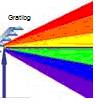
A surface appears smooth to the eye when the roughness is about half to eight times the measurement wavelength i.e., less than 500 nm (midpoint) for visible radiation) and when viewed at a high angle of incidence. At these texture levels, surfaces with small autocorrelation lengths and very low mean asperity roughness can appear bluish. However, the surface constituents (phases) effects described below often dominate. The colors of titanium, zirconium, and alloy oxynitrides range from red-yellow to blue/violet, indicating bandgap changes driven by variations in the oxygen/nitrogen ratio. Texture compositing can create many colors when different phases coexist at a surface. Thin-film interference, absorption coefficients, and internal scattering by small-scale phases like Fe2(CN) contribute to color formation. This is somewhat analogous to the prism light grating shown above. However, the closest scientific analogy to the tempering colors of oxides and nitrides is noted in water-droplet residual drying colors on a surface, the colorful wings of an attractive butterfly (morpho-color), the spectacular color separation obtained from a prism-light grating, the red-shift explanation from moving objects, and the commonly observed variations in the color of the sky and across moonbows and rainbows. However, few clear explanations comprehensively account for all oxynitride surface colors. Reflection, polarization, and a complex refractive index with a real part near 1.55 seem important, but much more remains to be learned about multi-scale roughness. Hairy bird colors. This roughness causes interference, driven by the minute surface structure of the skin or feathers of the bird, butterfly, beetle, or other creature we’re looking at. Incoming waves reflect off different parts of the surface by different amounts, producing the amazing colors we see in nature through iridescence.
What is GoldenBlue®, and what does it have to do with solar devices? Did you know that the Cascade e-ion could create photocatalytic or solar conversion surfaces? Please contact MHI to learn more about surface quantum dots. Pictures below show the spectrum of colors from prisms, diffraction, and atmospheric sunlight. The picture shows Baltimore Harbor at sunrise.
. 





Rainbows (see picture below) tell us about light, water, and our position. They show that sunlight contains many colors and that light bends and reflects in raindrops. Multiple reflections yield secondary rainbows. Because rainbows are an optical illusion, no two people see the same view. To see a rainbow, stand with your back to the sun and face falling rain or mist to spot the arc. Red light bends at a 42-degree angle. Other colors bend at different angles. Droplets must be larger than 1 mm, which means they are falling. The concentration is not high enough to blur the light, so it is much lower than in equilibrium clouds. Sunrise also provides a natural prism as shown above.
Product Questions? Please Contact Us.
What is Deburr? How does the Cascade e-ion change the surface roughness? Does it affect the surface color?
If you were wondering why IR radiation is heat, i.e., why radiation and thermal energy count as heat in thermodynamics, the table below, based on Noether’s ideas, will help.
| Principle | What it Explains! | Relationship to Radiation as Heat |
| Noether’s 1st Theorem | Continuous time symmetry creates energy conservation. | Proves that radiation energy and thermal energy can convert into one another. |
| Noether’s 2nd Theorem | Local gauge symmetry requires force fields. | Generates the electromagnetic field (photons) that carries the radiation. |
| Statistical Mechanics | Macroscopic states emerge from microscopic chaos. | Explains that radiation is disordered energy, which fits the definition of heat |
And finally connectivity: That is related to the entropy generation rate, that permits transitions from small worlds and large worlds. Across the de Broglie divide and based on symmetry and patterns.
Subscribe to Newsletter
Fahrenheit – Centigrade Conversion
T(°F) = T(°C) × 5/9 +32
Rankine – Centigrade Conversion
T(°C) = T(°R) × 5/9 – 273.15
Kelvin – Centigrade Conversion
T(K) = T(°C) +273.15
Radiative Products


Making Money with Electrothermal Products
Radiators


Cascade e-Ion Generator

Furnaces